
Self-Storage Market Trends 2026: What Athens Owners and Investors Should Know
Updated October 2026.
Self-storage has been working through a tough stretch: soft demand, slipping street rates, and a wave of new supply. The good news is that the pipeline is shrinking and the sector is on a slow path toward recovery. Here is where national self-storage trends stand in fall 2026, what they mean for Athens, and what owners and investors should be watching.
| Self-Storage Snapshot (National) | Latest Reading |
|---|---|
| Average advertised street rate (Aug. 2026) | $16.39 per SF, down 0.5% from July |
| Advertised rent change, year over year (July 2026) | Down 1.6% |
| Facilities in development (Aug. 2026) | 2,392 properties in all stages |
| Expected 2026 completions vs. 2025 | About 19% lower |
Source: Yardi Matrix national self-storage reports (August and September 2026).
Street Rates Are Still Soft, but the Decline Is Slowing
According to Yardi Matrix, national advertised rents fell 1.6% year over year in July 2026, with declines in 26 of its top 30 metros. Rates have continued to slip month to month, but at a slower pace. Weak home sales and limited migration have held back demand, since moving is one of the biggest reasons people rent storage, and oversupply in some markets has kept pressure on rates.
Revenue growth is limited for another reason: the gap between what existing tenants pay (in-place rates) and what new customers are offered (street rates). Operators have been competing for new renters with lower move-in rates, and that gap constrains how quickly income can recover. Yardi Matrix describes the sector as being on a slow and moderate track toward recovery.
New Supply Is Pulling Back
The brightest spot in the data is the pipeline. Yardi Matrix reports that deliveries fell across every major U.S. metro in the first seven months of 2026 and expects national completions to be about 19% lower than in 2025, with supply reductions continuing through 2028. A slower pipeline helps protect occupancy, although it usually takes time before reduced supply translates into stronger rates.
What This Means for Athens
Local self-storage performance depends on facility-level supply and demand, so national numbers are only a starting point. A few things stand out in Athens:
- Recent supply: According to StorageCafe, as reported by the Atlanta Journal-Constitution, Athens added roughly 96,000 square feet of new self-storage space in 2025, part of a broader expansion in college markets. Atlanta led the country with 2.2 million square feet delivered.
- Student and renter demand: The University of Georgia’s enrollment of more than 43,000 students creates steady turnover, with many renters moving in and out at semester breaks and lease ends.
- Apartment growth: Athens currently has 566 multifamily units under construction, according to CoStar, and renters in smaller units often turn to storage. See our Athens Multifamily Market Report for Fall 2026 for the details. Source: CoStar Group, October 2026.
The takeaway: Athens has demand drivers that many markets lack, but new storage deliveries within a few miles of a specific property can matter more than any national trend.
What Owners and Investors Should Watch
- The in-place vs. street rate gap: A facility with in-place rents well below current street rates may have upside, while one with rents above street rates may face pressure when tenants turn over.
- Economic vs. physical occupancy: Physical occupancy counts units that are rented, while economic occupancy reflects the income actually collected after discounts and delinquencies.
- Nearby competition: New facilities planned or under construction within a few miles can affect rates and lease-up.
- Climate-controlled demand: Climate-controlled units generally command higher rates, and the right mix of unit types matters.
- Expansion land and ancillary income: Extra land for additional units, tenant insurance, and retail sales can add to a facility’s value.
Self-Storage Property Types
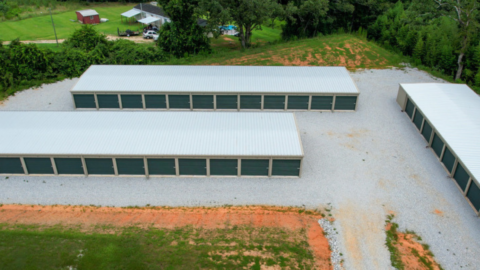
- Drive-up (non-climate-controlled): Single-story units with exterior doors that customers drive up to, usually the most affordable option.
- Climate-controlled: Indoor units with temperature and humidity control, often used for furniture, documents, and sensitive items.
- Multi-story: Larger indoor buildings, more common where land is expensive and visibility is high.
- Vehicle, RV, and boat storage: Outdoor or covered spaces for larger vehicles.
- Portable storage: Containers delivered to a customer and stored at a secure facility.
Self-Storage Market FAQ
Are self-storage rents going up or down in 2026?
Nationally, advertised rents have been falling slightly year over year in 2026, according to Yardi Matrix, though the monthly decline has been slowing. Results vary by metro and by facility.
Is there too much self-storage supply?
Some markets were overbuilt in recent years, but deliveries are slowing. Yardi Matrix expects national completions to be about 19% lower in 2026 than in 2025.
What drives demand for self-storage?
Moving activity, home sales, apartment living, college populations, small businesses needing inventory space, and general life changes such as downsizing all drive demand.
What is the difference between street rate and in-place rate?
The street rate is what a facility advertises to new customers. The in-place rate is what existing tenants are actually paying. The gap between the two affects revenue growth.
What is the difference between physical and economic occupancy?
Physical occupancy is the share of units that are rented. Economic occupancy is the share of potential income that is actually collected, which accounts for discounts and unpaid rent.
Is self-storage a good investment?
It depends on the market, the facility’s occupancy and rates, nearby competition, and the price paid. A property-by-property analysis matters more than a national average.
Talk With Us About Self-Storage in Athens
If you own a storage facility, are considering buying one, or are evaluating a site for development, our team can help you understand how local conditions affect value. Learn more about our Sales and Acquisitions services, browse our current properties, or contact us.
Sources: Yardi Matrix national self-storage reports (August and September 2026); StorageCafe via the Atlanta Journal-Constitution (December 2025); CoStar Group, October 2026.
Questions about commercial real estate investing in Athens?
Contact Brian Elrod, CCIM at 678-859-6110 or brian@naielrod.com
Related Articles:
Athens Multifamily Market Report | Fall 2026
Industrial Real Estate Types Explained: A Guide for Athens, GA
Industrial Real Estate Types Explained: A Guide for Athens, GA
Commercial Development Types Explained: Build-to-Suit, Infill and More
Commercial Development Types Explained: Build-to-Suit, Infill and More